
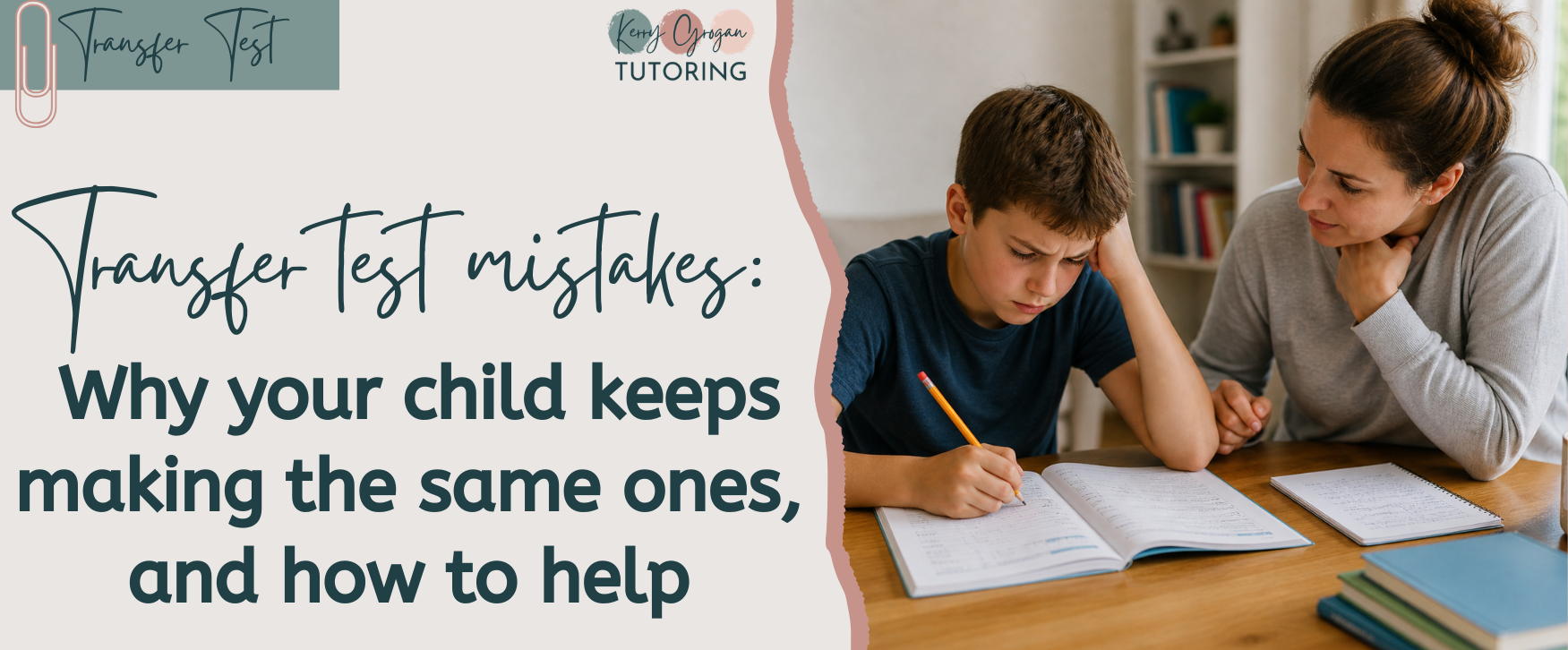
Let’s talk about a topic that can be super frustrating for you during SEAG prep and that’s transfer test mistakes. Transfer test mistakes have a funny way of repeating themselves, don’t they? Your child knows how to do the thing, you’ve watched them do it perfectly a dozen times, and yet here it is again, the same silly slip, the same dropped mark, the same, “Oh, I didn’t read it properly.”
If you’re sitting there thinking, “Why does this keep happening?” take a breath and don’t panic. The good news is that these repeated mistakes almost always have a cause, and once you can spot it, they’re far easier to fix than you’d think. Let me help you unscramble what’s really going on.
First, know this: it’s rarely about ability
Right, let me say the most important thing straight away. When a child keeps making the same small mistakes, it’s hardly ever because they can’t do the work. They usually can. That’s the very thing that makes it so frustrating for you both.
Repeated transfer test mistakes are almost always habit mistakes, not knowledge mistakes. Your child isn’t stuck because the maths is too hard or the comprehension is beyond them. They’re slipping on the same predictable things, and predictable is exactly what we can work with. So before anything else, let go of the worry that these mistakes mean your child isn’t able. They almost certainly are. We just need to tidy up a few habits.
The usual suspects (you’ll recognise these)
Most repeated mistakes fall into a handful of familiar patterns. Have a read and see which ones ring a bell in your house.
- Rushing. The big one. Your child races through, keen to be finished, and misses the detail. Speed feels like success to them, so they don’t realise it’s costing them.
- Not reading the question properly. They answer the question they expected, not the one that’s actually there. “Find the difference” gets added instead of subtracted. It happens constantly.
- Careless slips in familiar work. Copying a number down wrong, forgetting to carry, missing a minus sign. Not a gap in understanding, just autopilot.
- The same topic every time. If it’s always fractions, or always the inference questions, that’s a specific wee gap worth a bit of focused attention.
- Losing concentration near the end. Tired brains make more errors, so mistakes that cluster at the end of a session are often just fatigue.
Notice how few of those are about not knowing the maths or the English. Almost all of them are about how your child is working, not what they know.
How to actually help (without nagging)
Here’s the bit that matters, and I’ll be honest, “stop making silly mistakes” is not a strategy. Telling a child to be more careful rarely works, because they’re not being careless on purpose. Instead, we gently build the habits that catch the slips.
The single most powerful one is teaching your child to slow down and read the question twice before they answer. I know it sounds almost too simple, but so many transfer test mistakes vanish the moment a child actually reads what’s being asked. Get them into the habit of underlining the key bit, what’s the question actually looking for, before they pick up the pencil.
After that, teach them to check their work, not by glancing over it, but by actually redoing a tricky step. And keep a gentle eye on patterns yourself. If the same type of slip keeps appearing, that’s your signal to spend ten calm minutes on just that thing, rather than more of everything.
And keep sessions short. A tired child makes more mistakes, so a fresh ten minutes will show you their real ability far better than a long, weary session ever will.
Turn mistakes into something useful
Here’s a wee mindset shift that helps enormously, for you and for your child. Mistakes in practice are not a bad thing. They’re actually the whole point.
Every mistake your child makes at the kitchen table is a mistake they’re less likely to make in November. Practice is exactly where you want the slips to happen, because that’s where you can catch them, understand them and fix them. So try not to sigh or groan when a familiar error pops up again (I know, easier said than done). Instead, get curious with your child. “Ah, what happened there? Let’s have a look.” A calm, curious response teaches them that mistakes are just information, not failures.
A child who’s terrified of getting things wrong tenses up and makes more mistakes. A child who sees mistakes as part of learning relaxes, and relaxed children think far more clearly. You know your child best, so you’ll know how to keep it light.
When to just leave it
One last honest thing. Some days, the mistakes are just tiredness or an off day, and the kindest
, smartest thing is to close the book and try again tomorrow.
Not every error needs analysing. If your child is worn out, wound up, or clearly not in the zone, pushing on only makes for more mistakes and more upset. There’s no prize for finishing a session in tears. Consistency over the months matters far more than winning any single evening, so give yourself permission to call it a day when a day needs calling.
More information on transfer test mistakes
- 5 common SEAG prep mistakes and how you can avoid them
- 5 Subtle Signs of SEAG Revision Burnout in Your Child and How to Help
- The official SEAG website for test information, dates and registration
- BookTrust for building the careful reading that catches so many slips
- Words for Life from the National Literacy Trust, for reading support at home
If your child keeps making the same small mistakes, please don’t despair, and please don’t take it as a sign they can’t do it. Repeated mistakes are habits, and habits can be gently changed. Slow them down, read the question twice, spot the patterns, and treat every mistake as useful information rather than a disaster. Keep it calm and keep it curious, and those transfer test mistakes and silly slips will quietly start to disappear.


